




Most “best SEO expert” lists online are written by the experts themselves or by agencies with something to sell. That makes them close to useless if you’re actually trying to hire someone. This one is built differently: it’s a vetting checklist first, and a shortlist second, so you can judge any freelancer against the same standard, whether they’re on this list or not.
At Globials we work with B2B and B2C clients across multiple markets, and one question comes up constantly from founders and marketing leads: should we hire an agency, a freelancer, or build in-house? For a lot of businesses, especially ones that don’t yet need a full team, a skilled individual freelancer is the most efficient option. The trick is knowing how to separate someone who genuinely does the work from someone who is reselling it.
How to Actually Vet a Freelance SEO Expert
Before naming names, here’s the filter worth applying to anyone you’re considering, on this list or off it:
- Ask to see their own site’s search performance. Someone who can’t rank their own portfolio site has a hard time explaining why they’ll rank yours.
- Ask what tools they use daily. A real practitioner names specific platforms (Search Console, a crawler tool, an analytics stack) without hesitation. A reseller gives a vague answer.
- Ask for one technical fix they’ve made recently. Not a “traffic went up” story, an actual example: a redirect chain they cleaned up, a crawl budget issue they solved, a Core Web Vitals fix.
- Check whether they’re pitching a package or diagnosing your site. Anyone quoting a price before looking at your actual website is selling a template, not a solution.
With that filter in mind, here are five individual freelancers in Pakistan worth knowing about, each with a genuinely different specialty.
Five Freelancers, Five Different Specialties
1. Syed Sheraz Shah — Technical SEO and WordPress
Syed Sheraz Shah has built a 9-year practice almost entirely around technical problem solving: the crawl errors, indexing bugs, and slow load times that quietly cap a site’s ranking potential no matter how good the content is. His background and case history are on expertseofreelance.com, and he’s reachable directly through his LinkedIn profile.
His specialty inside WordPress specifically is worth calling out: plugin conflicts, bloated databases, and index issues caused by messy site structure are common on WordPress, and most generalist freelancers don’t dig deep enough to actually fix them. He also works on Local SEO for service businesses and has moved early into Generative and Answer Engine Optimization, positioning client sites to be cited by AI tools, not just ranked in traditional search.

For business owners who’d rather learn than outsource entirely, he also runs a short local SEO coaching program, 8 hours total over a month, aimed at people who want enough working knowledge to manage their own Google Business Profile and basic on-page fixes.
- Best Suited For: Businesses with an underperforming WordPress site, or anyone needing local map visibility fixed properly.
- Main Strengths: Technical audits, WordPress-specific fixes, Local SEO, and early AI search optimization.
2. Saad Raza — Site Audits and Structural Cleanup
Saad Raza’s work is almost entirely diagnostic: going through a site systematically to find what’s broken before anything else gets touched, crawl issues, structural problems, and pages that are effectively invisible to search engines. More at saadraza.com.

- Best Suited For: Larger e-commerce and corporate sites where structural issues multiply across hundreds of pages.
- Main Strengths: Deep technical audits, structural fixes, keyword-to-page mapping.
3. Rafay Waqar — Strategy Tied to Business Outcomes
Rafay Waqar’s differentiator is that he builds plans around what a business actually needs to grow, inquiries and sales, not raw traffic. His reporting is built to be readable by a founder, not just an analyst. See his work at meetrafay.com.
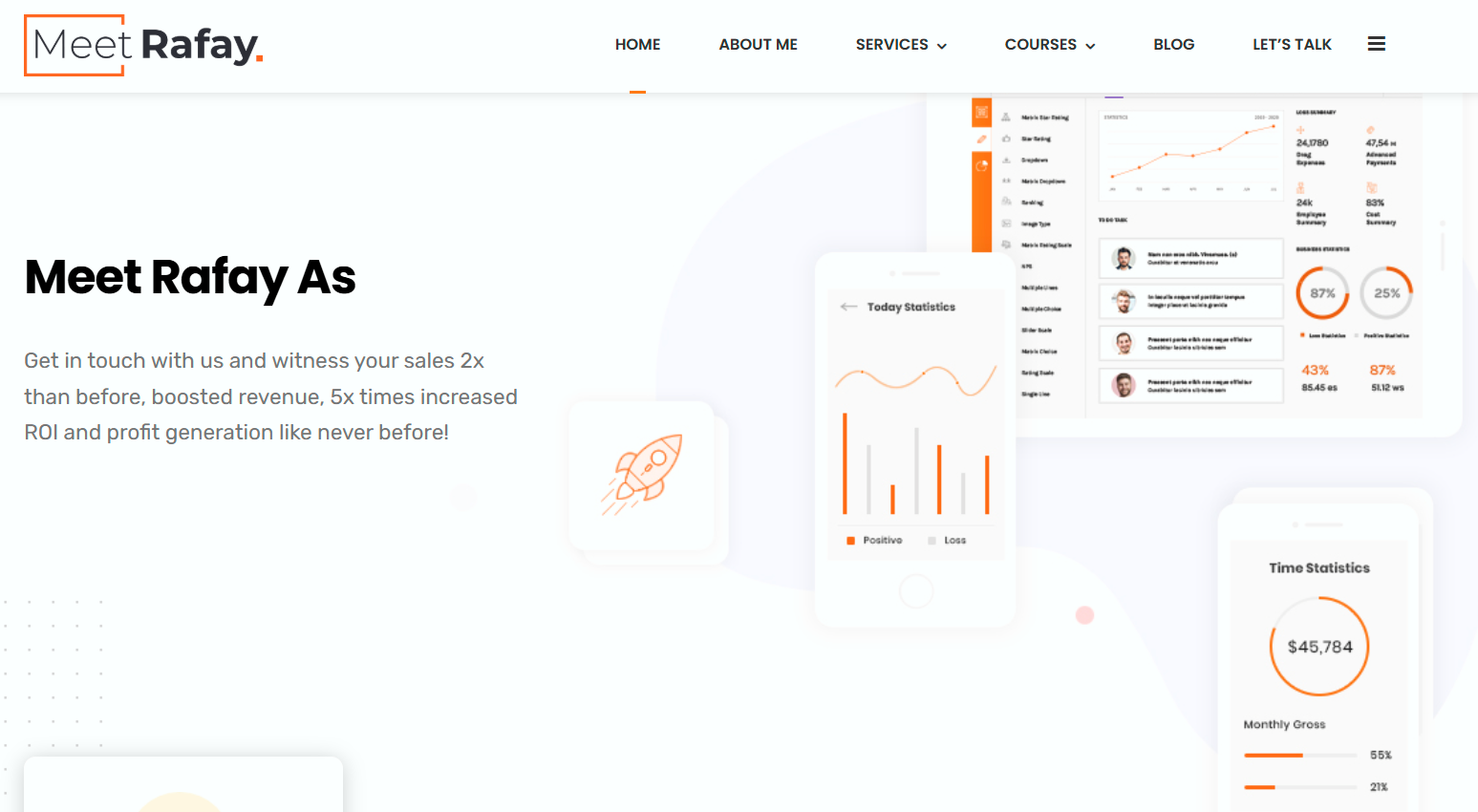
- Best Suited For: Business leaders who want plain-language reporting tied directly to leads and revenue.
- Main Strengths: Data-driven strategy and conversion-focused optimization.
4. Rameez Ul Haq — Local and Google Business Profile
Rameez Ul Haq works almost exclusively on local visibility, getting a business to show up in the map pack when someone nearby searches. That includes profile optimization, review strategy, and the on-page signals that back up local rankings. Site: rameezulhaq.com.
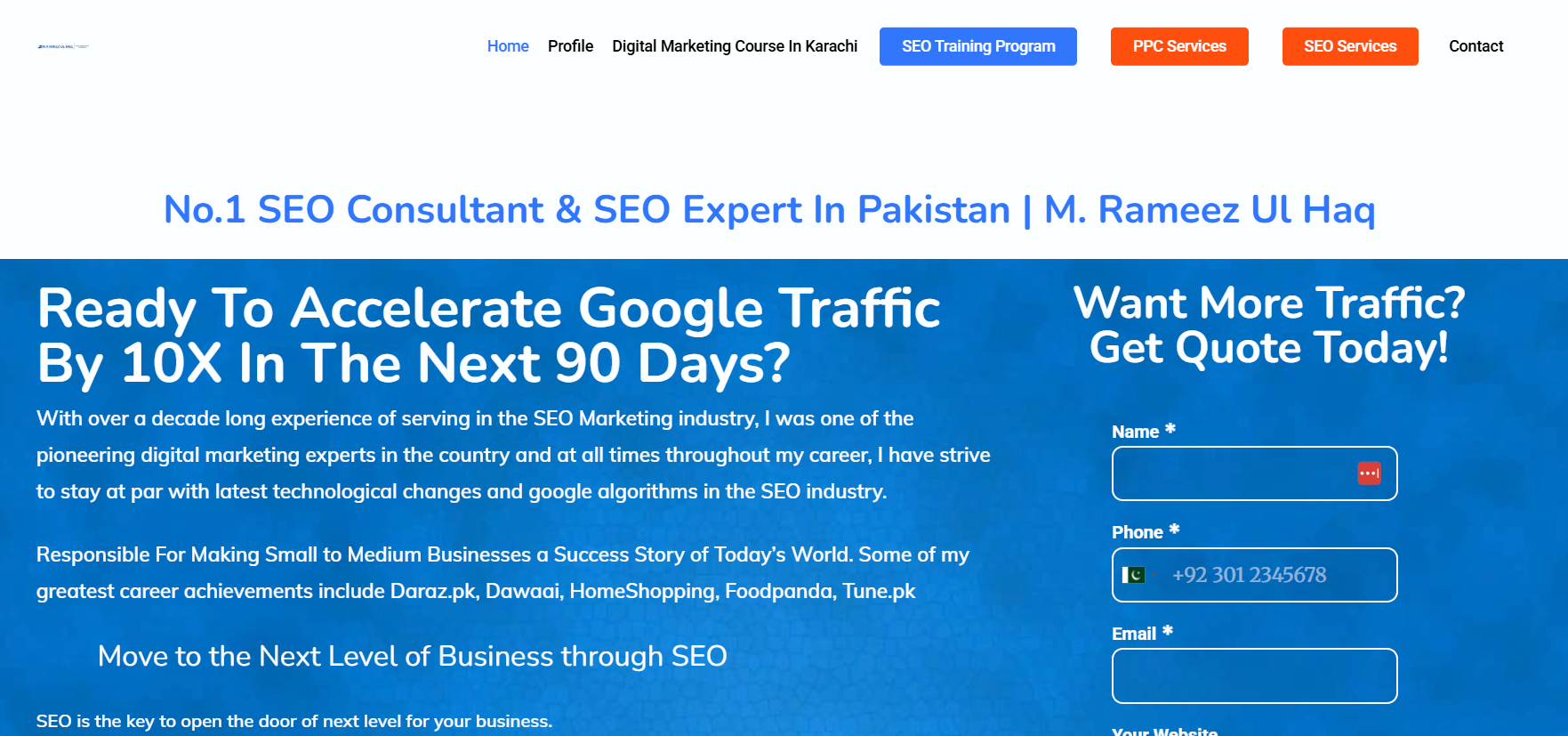
- Best Suited For: Physical stores, clinics, and any business relying on nearby customers finding them on Maps.
- Main Strengths: Google Business Profile management, local map rankings, review management.
5. Imdad Malik — Enterprise Architecture and Semantic SEO
Imdad Malik’s focus is large, complex sites where structure and topic relationships matter as much as individual pages. He works on structured data and semantic organization to help large platforms stay legible to modern search engines. Portfolio: TechNovaVista.
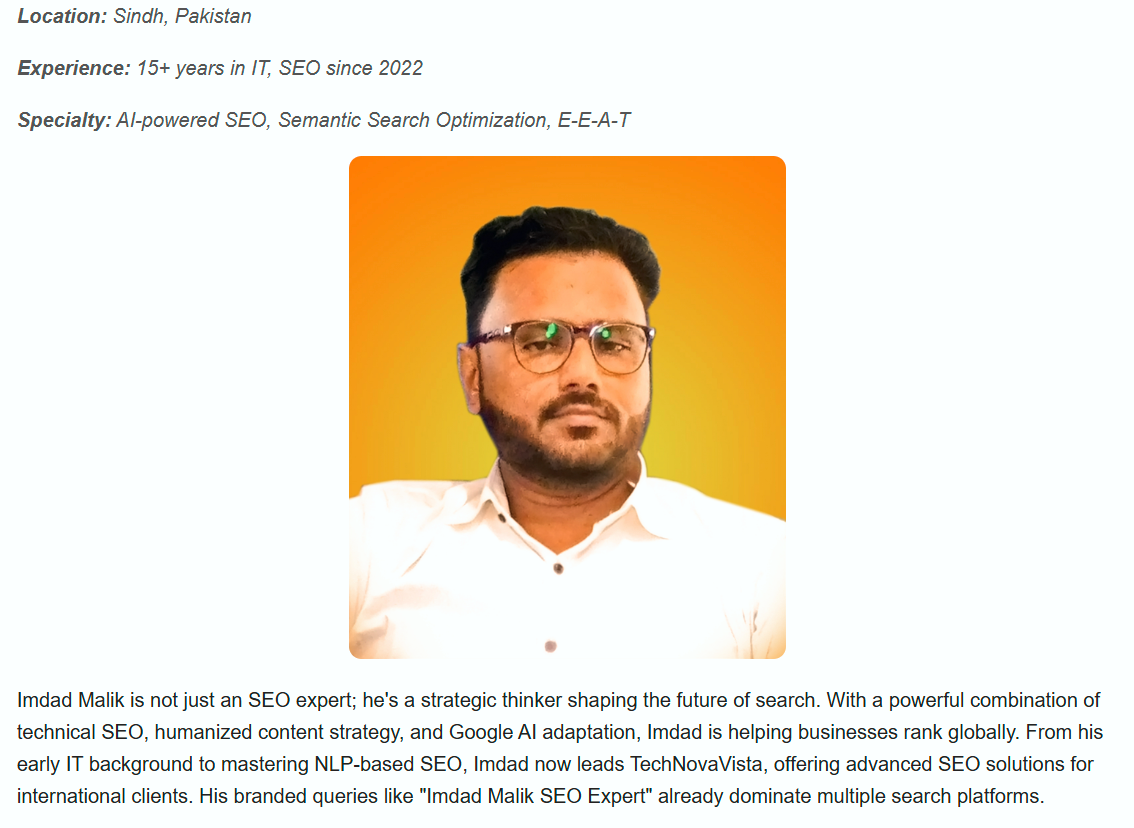
- Best Suited For: Large web portals, international sites, and complex web applications.
- Main Strengths: Advanced site architecture, semantic search optimization, AI platform visibility.
A Quick Diagnostic: Is Your SEO Problem Technical or Content?
Business owners often default to “we need more content” when the real issue is structural. A rough way to tell the difference:
- If your pages rank for the wrong keywords, or don’t rank at all despite existing for months, that’s usually technical: indexing, crawl budget, or site structure.
- If your pages rank but visitors leave immediately, that’s usually content: the page isn’t actually answering what the searcher wanted.
- If your traffic is fine but leads aren’t, that’s usually conversion: the page ranks and gets read, but doesn’t move people to act.
Getting this diagnosis right before hiring anyone saves months of paying for the wrong fix.
Case Study: A B2B Firm That Was Investing in the Wrong Layer
A professional services firm came to us convinced their problem was a lack of content. They’d been publishing two articles a week for a year with almost no traffic growth to show for it. A technical review told a different story: over 40 percent of their published pages weren’t indexed at all, due to a misconfigured robots file and a sitemap that hadn’t updated automatically in months.
Once the technical layer was fixed, indexing rate, sitemap accuracy, internal linking, existing content started ranking within weeks, without a single new article being published. Traffic more than doubled in the following quarter from content that had already been sitting on the site, unseen by Google, the entire time.
The lesson: more content doesn’t fix an indexing problem. It’s worth ruling out the technical layer before assuming you need to write more.
Mistakes That Cost Businesses the Most
- Hiring based on a sales call instead of a site audit. Anyone confident enough to quote a fix before seeing your site is guessing.
- Buying backlinks in bulk. Cheap, spammy links are one of the fastest ways to damage a site’s trust with Google.
- Assuming more content always helps. As above, if the technical layer is broken, new content just adds to what isn’t getting indexed.
- Ignoring mobile performance. The majority of searches happen on a phone; a slow or broken mobile experience loses visitors before they read anything.
- Expecting results in days. Real ranking movement takes three to six months. Faster promises usually involve tactics that backfire later.
Where This Is Heading
A few shifts worth planning around rather than reacting to later:
- AI answer engines are becoming a real traffic source. Content that states facts clearly and directly is more likely to get cited by tools like AI Overviews or ChatGPT.
- Demonstrated experience is starting to outrank generic content. Google’s systems increasingly favor pages that show firsthand knowledge over rewritten summaries.
- Brand mentions are becoming a trust signal in their own right. How often and how credibly a business is mentioned across the web is starting to matter as much as backlinks.
Frequently Asked Questions
Should I hire a freelancer or an agency?
It depends on your size and complexity. A skilled individual freelancer is often the better fit for small to mid-size businesses that need direct, hands-on work rather than account management layers. Larger or more complex sites sometimes need the broader team an agency provides.
How do I know if my SEO problem is technical or content-related?
Use the diagnostic above: pages that don’t rank at all point to technical issues, pages that rank but don’t convert point to content or messaging gaps.
How long does SEO actually take to show results?
Typically three to six months for meaningful movement, since Google needs time to recrawl changes and reassess trust signals.
What’s the biggest red flag when evaluating a freelancer?
Anyone quoting a fixed price or guaranteed ranking before actually reviewing your site. That’s a sign you’re being sold a package, not a diagnosis.
Can Syed Sheraz Shah help with training our internal team instead of outsourcing entirely?
Yes. He runs a compact local SEO coaching program built for business owners who want working knowledge of Google Business Profile management and basic on-page fixes rather than a full outsourced engagement.